Bartering in a Post-Cataclysm World

because we all know its worth its weight in cows...

Ok, so ive been thinking. The major influx of citizens is supposed to be made up of people from "the wilderness" looking for protection from an almighty channeler. These people are survivors of a Cataclysm that destroyed civilization as they knew it. Most likely, multiple generations have passed, and for all the little ones, the stories their elders tell them of great kingdoms are all but fairy tales.

So why would these people give a crap about a coin? The bartering system would be far more plausible as a way of survival, at least in the beginning. I would like to see it done so that you would have to convince your people to use the gold you find throughout the land as currency, thus actually creating an economy. Otherwise, gold is just being created from nothing and to me that seems very silly.

I mean think about it, if a nuclear war broke out tomorrow, we all would hope that some of the worlds population would manage to survive. Slowly, small groups of people would band together to protect one another (thus creating something similar to the tribes of old). As these groups reproduced and started to grow, the children would know nothing about their parents lives except the stories they were told of tv's and world wide webs, which most likely would seem fictional and a sort of fairy tale to them. When different groups started to find one another, a form of bartering would most likely surface. "My people have excess deer meat, can we trade for some of those tarps to catch clean rain water?" or whatever is needed, you get my point. These people, these survivors, could care less about a U.S dollar bill for it wouldn't matter, and people would see it for what it actually is: paper. I can't see a point when money would actually come back into use, because to me, it seems unnecessary with such a small group of people.

So I think that Elemental, especially with the angle at which its coming from with its story, should set a new precedent for strategy games, and make the economy (and development of) actually mean something. Gold, in the beginning, would be worthless compared to such things as lumber and food. Yet, after a while, when you find old gold pieces scattered throughout the land and start circulating it through your civilization it would gain value and worth.

Comments? Suggestions?  |-)  

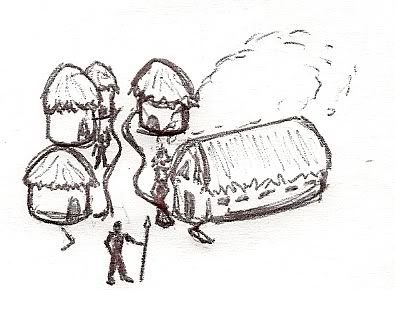
I thought you'd all like to see my stick village doodle from when i was brainstorming all this :inlove:  

12,007 views 13 replies
Reply #1 Top

I'm a bit too tired to get involved in a discussion of a no coin bartering system, argueing in the favour of the coin. That said, its probally difficult to represent a civ's actual economic power when restricted to a bartering system. You might have to use the "coin" system (in a symbolic manner) regardless of the actual economic system used by your civilization. I think it would be more trouble than its worth trying to renegociate the contracts of many soldiers who are tired of getting "deer hides" or other goods to pay for their services.

...
...
I think I just argued the point despite saying I was too tired to do so...

/face palm self

I think my point is, you'll reinvent the coin system because you need it as it makes life simplier.

Reply #2 Top

I agree with DivineWrath from a suspension of disbelief standpoint. Also, from a gameplay standpoint it seems like it would just be a pain, both to implement and to play.

Reply #3 Top

Actually, you are completely correct. However, elemental takes place once cities start to populate the world, and at that point, resources are no longer in as much demand as specialized labor. Once the problem of scarcity is relieved, people begin to persue specialized craft, and that is what you see as soon as you create a city, how else would you be able to actually research new technology? Someone has to be capable of researching. People don't have the free time to learn such things in a society with a scarcity of resources, as their main concern is food production. As far as it would concern your civilization, money would be just as, if not better than actual resources, for trade and allocation of payment/resources. As I see it, this scenario would be fairly similar to the first city states in Sumeria, one of the earliest examples of such an emergence.

Reply #4 Top

While I think a no-coin economy would be a non-starter, I certainly agree that basic materials should be worth a lot more at the beginning of the game, and are more common and less valuable as the game goes on.

Reply #5 Top

lol i just remembered this, in the past some chiefs and kings would pay their warriors beef or some other equavilent (in feudal japan samuria for a time were paid in rice) centuries, if not millenia, after currency was introduced. so imagine that you're a king and it's pay day....there goes a cow or twelve.

now while i do agree that a bartering system used as a early stage of commerce would be fasinating from an intellectual stand point. But in use it would be an unnecessary hassle for both the designers to implement and confusing for gamers. of course, this doesn't mean that you can't barter with other nations (a common game mechanic in all 4x games).

on resources be scarce at the beginning of a game, i agree for that to be a must and from what i read from previous journal entries, frogboy has more or less taken care of this. as i understand, cities naturally produce the basic resources but without specialized buildings they only produce these in very small amounts (either 0.1 or 0.01 of a unit) per turn thus making them more scarce, and more valuable) early in the game. so say you want to produce more metal resources you would need things like mines (to gather), smelting furnaces (to refine) in order to acquire greater amounts per turn.

====================================================================

QUOTE: "Would you believe me if I told you it was a well planned act of recklessness with a liberal shot of stupidity?"

Reply #6 Top

Oooh, great Idea for a Military Civic (Feudal-State)- can choose to pay your troops either food or gold (+ some other bonuses, + some penalties, all based on having the military be the highest class in society)


possible bonuses including greater experience bonus for newly trained units, or added bonuses to your top X current units.

Reply #7 Top

Oh yes, I could definitely see this working in a feudal civilization structure, or manorial structure(kinda the same thing). I didn't see elemental as having these traits though, other than the vassalage system that seems more of an added feature than a core part of the game. Really, though, money has been used for more than 4,000 years, only during the darkest times of human history have a majority of the world's sedentary population used no kind of money.

If I am wrong and Elemental is supposed to resemble a feudal/manorial system, then this concept would make sense to implement, however...it would be far easier to not do so and have the civilizations resemble more centralized civilizations.

Reply #8 Top

I'm pretty sure that strong majority opinion amongst both devs and players will demand that the 'gold piece' be a fundamental unit of the Elemental economy. But I believe that RisingLegend is onto something that's long vexed me as a GC2 player: the game engine needs to be flexible enough to support no-currency market 'interfaces' even if the RTM interface hides all that behind a traditional gold piece approach.

In semi-fancy book-larnin' terms, the problem is a failure to distinguish use value from exchange value in a way that would support both primitive, post-Cataclysm barter economies and fantastic/fictional/utopian economies like a Tolkien elven kingdom or the United Federation of Planets. To get really abstract about it, gold might still have significant trade value in a non-money culture because it is a highly flexible, beautiful material to use for creating prestige objects like jewelry and shiny domes on buildings.

Reply #9 Top

Off-topic warning.

Quoting GW, reply 8
I'm pretty sure that strong majority opinion amongst both devs and players will demand that the 'gold piece' be a fundamental unit of the Elemental economy.
End of GW's quote

Elemental should try to offer us new things. Even in coins. Maybe I should start a thread about which kinds of coins should be used in Elemental. I vote for Orichalcum.

Reply #10 Top

While its true that bartering would dominate initially, with national banks collapsing, there's no reason that a free city wouldn't evolve beyond bartering once it was established.  I mean the Lore might be of like a post-nuclear meteor strike, and the people only trade in dog skulls and canned goods, but established free towns could quite likely reinvent coinage, once they achieve population growth and trades again.

Reply #11 Top

Quoting GoodGame, reply 10
While its true that bartering would dominate initially, with national banks collapsing, there's no reason that a free city wouldn't evolve beyond bartering once it was established.  I mean the Lore might be of like a post-nuclear meteor strike, and the people only trade in dog skulls and canned goods, but established free towns could quite likely reinvent coinage, once they achieve population growth and trades again.
End of GoodGame's quote

Maybe yes, maybe no. The point for some of us civs-as-toys gamers is that we want to play with possibilities, not just a particular thinker's ideas about 'reality.' Whether and how a given post-cataclysmic Elemental society would (re)develop currency is at least as much a matter of culture as it is of material circumstances. Some cultures simply do not value the 'efficiency' of currency in the same way that others do, and in our 'real-world' currency systems might have an unreasonably strong rep just by luck of having been strongly associated with military-industrial technologies. The war-engineers could just as easily have shunned coinage as yet another Greek perversion best left in the pre-Hellenic dust; it might have slowed some related economic processes down, but faster is not always better in the long haul.

To make sure that I'm as confusing as possible, I'll point to the pre-Colombian Atecs, who used cacao beans and standard lenghts of cotton cloth as 'currency' for most commercial transactions. Despite lacking steel and gunpowder, the Aztecs were otherwise as highly or more sophisticated a society as many from Europe and the classical Mediterranean. They had a stratified culture with many staple food commodities, a much cleaner way of building and maintaining cities than anything in Europe since the fall of Rome, and a wide range of status goods. But their common money was a very direct fusion of use and exchange value. Cocoa drinks and sauces are delicious and pretty much everybody likes having cloth around their bodies and homes. The Aztec commercial economy made ordinary traders decide between hitting the market or staying home wrapped in comfy robes and enjoying a good mole (the sauce, not the rodent) on their roasted guinea pigs.

Reply #12 Top

But to be fair, trade in item becomes currency once it develops and abstract value.  I confused that point somewhat above.  So really it's not whether or not the coins are made of metal, are round, or have square pegs stamped in the middle, or are cotton cords, they're currency if their manufacture is relatively centralized, and they abstractly represent trade.

Barter is strictly trade of services for services.  So it's logical that most large cities will develop a currency, if they develop a government, unless its run by some despot with an anarchic economic policy.  At which point there's the question if that city would be stable enough to support population growth.

But really, all of us gamers is thinkers, and the game designer hacks out a ruleset that's playable. :)

Reply #13 Top

But to be fair, trade in item becomes currency once it develops and abstract value.
End of quote

I mentioned the Aztec 'currencies' because I'm unable to get off my use value vs. exchange value hobby horse, and most modern people instinctively understand currency as fully abstract exchange value, even if there might be a few metal coins with very limited use value at the bottom end of the scale of currency units. Even when a useful item like cacao beans comes into use as an exchange medium, it is still also a very desirable commodity in its own right. The Aztec case gets even weirder because unlike gold coins, cacao beans and bolts of cotton cloth are perishable (not that I expect Elemental to pay much attention to perishable vs. imperishable inventory; the economy stuff seems firmly on a path to being 'simple').